
Rock Climbing in the Aosta Valley
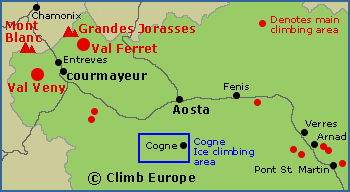
The Aosta Valley (Valle D'Aosta) runs from Courmayeur to Pont-Saint-Martin, in the northwest corner of the Italian Alps. This this compact area hosts over 100 sport climbing crags with many single pitch and multi-pitch rock routes on well bolted gneiss rock. With a good mixture of valley and high-altitude crags, these routes are spread across a good range of grades (F3’s to F8’s) with many delicate face climbs that range from 10m to over 350m long.
What guidebooks are available for climbing in the Aosta Valley?
1) The comprehensive Valle D’Aosta Sport Climbing describes around 5,900 sport routes, including many multi-pitch routes up to 350m long along the whole of the Aosta Valley.
2) The comprehensive Aosta Valley Rock Climbing Guidebook – Crags, Volume 1 describes the sport climbing on the eastern side of the Aosta valley around the town of Pont-Saint-Martin.
3) The Plaisir Sud Band 2 guidebook is a selective guidebook describing both single pitch and multi-pitch sport routes that includes the Aosta Valley.
When is the best time of the year to sport climbing in the Aosta Valley?
There are many side valleys off the main Aosta Valley that reach relatively high altitudes and are densely packed with crags. These high-altitude crags are perfect in the summer, making it possible to enjoy cool climbing in the shade of Alpine peaks, often away from the crowds. From the autumn to the spring there are many crags in the lower valley, often allowing for sunny climbing even on the coldest days. The Aosta Valley is in the rain shadow of Mont Blanc. When it is wet and cold in Chamonix, a quick drive through the Mont Blanc tunnel can often find dry and warm rock in the Aosta Valley.
Mountaineering on the Italian side of Mont Blanc
The Aosta Valley, and in particular Courmayeur, is the gateway to the Italian side of Mont Blanc. Here there are many excellent Alpine rock climbing routes on huge granite towers and spikes, with some of the classic areas being Tacul, Capucin, Pavillon, and the Grande Jorasses.
Many of the routes on Mont Blanc finish at an altitude of over 3,000m, with the routes typically being from a few hundred metres to around 1,500m long. This is Alpine climbing, so whilst there will be some fixed gear such as bolts or pegs on the routes, trad gear such as cams and nuts are also required. Even the approaches can be a serious undertaking as getting to the base of the majority of the routes it is essential to be competent in moving over glaciers.
The climbing on the Italian side of Mont Blanc is split into 3 distinct areas, these being Val Veny, Brenva (accessed via the cable car), and Val Ferret. Starting from Courmayeur many of these routes will usually take more than a day to complete requiring an overnight stay at one of the mountaineering huts, or under the stars at the base of the route. Situated along the Val Ferrat is the classic high-altitude crag of Dalmazzi. Here there are many multi-pitch routes ranging 200m to 370m long. In the main these are purely sport routes, though the occasional route does also require some trad gear such as nuts and cams.
Map of the main rock climbing areas in the Aosta Valley and around Courmayeur
What guidebooks are available for mountaineering on the Italian side of Mont Blanc?
1) The Mont Blanc: Italian Side Rock Climbing Guidebook is a comprehensive guidebook split into 66 Alpine rock climbing areas on Mont Blanc including Tacul, Capucin, Pavillon, and the Italian side of the Grande Jorasses.
2) Mont Blanc Granite - Val Veny is a selective guidebook covering the Val Veny area from the Aiguille du Chatelet to the Tour de Jethoula, describing 116 routes.
3) Mont Blanc Granite - Val Ferret is a selective guidebook covering the Val Ferret area from Pointe Gassi to the lower buttresses of the Aiguilles Rouges de Triolet, describing 248 routes.
Buy these guidebooks for the Aosta Valley from our shop.
Cogne Ice Climbing
The resort of Cogne is location in the south side of the Aosta Valley on the edge of the Gran Paradiso National Park. The high concentration of easily accessible ice routes in this area make the Cogne region one of the most popular and well-known ice climbing destinations in the World. Cogne also enjoys some of the most reliable ice climbing conditions in the Alps, as many of the routes are around 2,000m above sea level. The ice climbing varies from icefalls around Lillaz, Valeille and Valnontey to the wild, remote alpine routes around Rhemes, Grauson and Urtier. Read an articel by Ian Wyatt on why Cogne, and in particular, the Cascade de Lillaz is one of Europe’s most accessible ice climbing destinations. Read more...
The Cogne Selected Ice Climbs Guidebook describes 400 ice climbs around the valleys of Cogne, Urtier, Grauson, Lillaz, Valeille, Valnontey, Valsavarenche and Valle di Rhemes.